9 Steps That Turn Your Ideas Into Action Before You Talk Yourself Out of Them
You have good ideas. Probably more than you realize. The problem isn’t the quality of your thinking, it’s the gap between thinking and doing, and how quickly that gap fills with doubt, delay, and the quiet erosion of momentum.
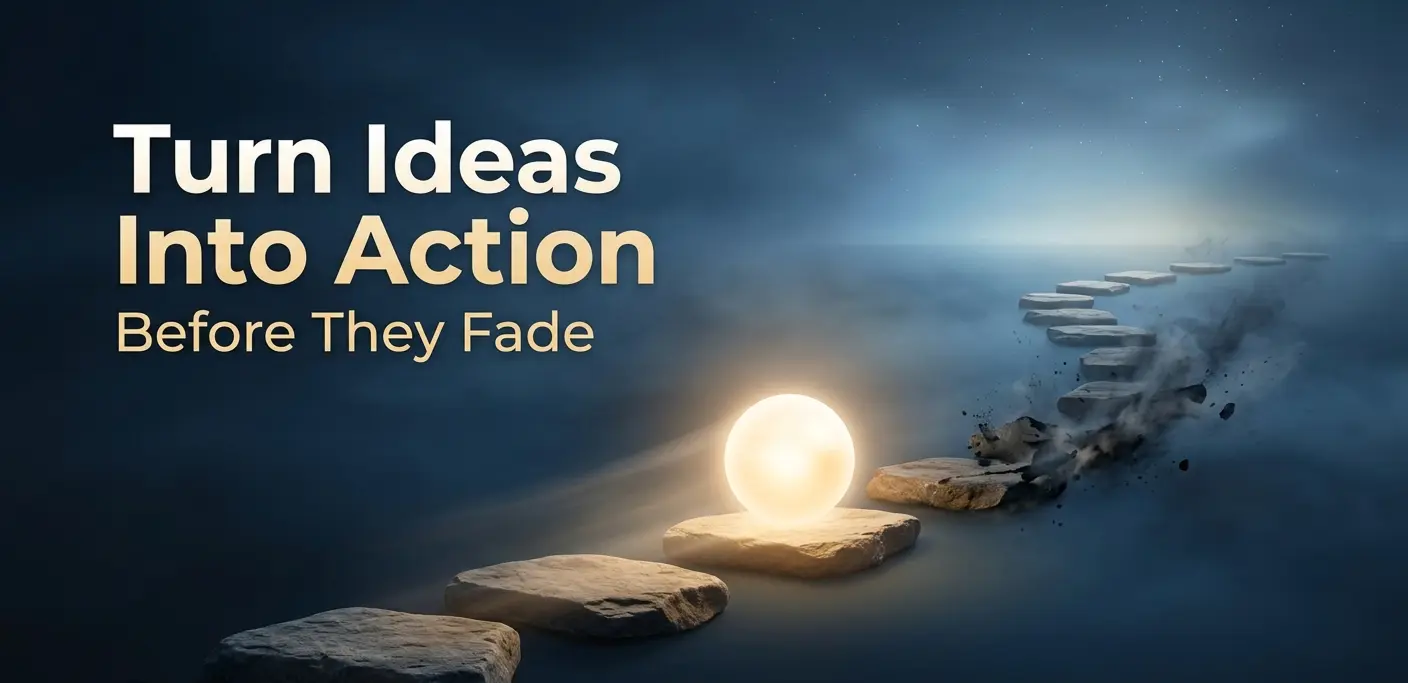
Most ideas don’t die dramatically. They fade. They get refined into abstraction, postponed for better timing, or buried under the weight of everything that needs to be figured out first. And then one day you see someone else doing the thing you once thought of, and the feeling that follows is both familiar and avoidable.
These nine steps won’t guarantee every idea succeeds. They’ll guarantee that your ideas actually get a chance.
When the Idea Lives Only in Your Head
The Situation: You have a clear vision in your mind. But it stays there, circling, elaborating, never quite landing anywhere concrete. The longer it spins, the more abstract it becomes.
The Step: Write the idea down in one sentence the moment it arrives.
The Insight: An idea captured immediately becomes something you can work with. An idea left in your head becomes something you manage by revisiting it, protecting it, worrying it might slip. The act of writing isn’t just documentation; it’s commitment. It moves the idea from mental real estate into the world, where it can be examined honestly. One clear sentence forces the vague feeling into a specific shape, and specific shapes can be acted on.
“An idea you haven’t written down is a wish. An idea on paper is a starting point.”
Action: Keep one dedicated place, a notes app, a notebook where ideas land immediately. No filtering. Just capture first.
When You’re Waiting Until the Idea Is Fully Formed
The Situation: You’re not ready to start because there are still things you haven’t figured out. So you keep developing the idea internally, adding detail, anticipating problems until it feels complete enough to begin.
The Step: Identify the smallest version of the idea that can be tested right now.
The Insight: Fully formed ideas are a myth. Every idea has unresolved parts, and most of those parts can only be resolved through execution, not more planning. The minimum viable version isn’t a compromise. It’s a learning device. It gives you real information that no amount of internal development can provide. The idea gets better through contact with reality, not through extended isolation from it.
“You don’t need the full plan. You need enough to start and enough honesty to adjust.”
Action: Ask yourself: What is the smallest version of this I could put into the world this week? Start there, not with the complete vision.
When Research Becomes a Substitute for Starting
The Situation: You’re gathering information. Reading, watching, preparing. It feels productive because technically it is, but weeks pass, and the idea is still in the research phase, waiting for a threshold of readiness that keeps moving.
The Step: Set a research deadline and treat it as non-negotiable.
The Insight: Research without a deadline expands to fill available time because it’s more comfortable than beginning. There will always be one more useful article, one more person to talk to, one more variable to understand. At some point, additional information produces diminishing returns, and the cost of continued preparation exceeds the cost of an imperfect start. The deadline isn’t arbitrary. It’s a protection against the kind of preparation that never ends.
“Preparation becomes procrastination the moment it starts replacing action instead of informing it.”
Action: Give yourself a fixed research window of two days, one week, whatever the idea genuinely requires. When it ends, you start regardless of how ready you feel.
When Fear of Judgment Is Dressed Up as Perfectionism
The Situation: The idea isn’t ready to share because it needs more work. The work, somehow, is never quite finished. The thing you’re actually protecting against isn’t incompleteness, it’s the exposure of being seen trying.
The Step: Separate the work of refining from the fear of being evaluated.
The Insight: Perfectionism is often fear with better branding. The standard keeps rising, not because the work requires it, but because meeting it would mean releasing something into the world where it could be judged. The insight isn’t to lower your standards, it’s to be honest about which improvements are genuinely serving the work and which are serving your avoidance. Those are different activities requiring different responses.
“Done and imperfect teaches you more than perfect and unshared ever will.”
Action: Show the current version of your idea to one trusted person this week. Not for approval for perspective. Let the work exist outside your head.
When You Have the Idea but No Clear First Move
The Situation: You know what you want to build. You just don’t know where to begin. The whole picture is visible but overwhelming, and the size of it keeps you standing still at the entrance.
The Step: Define the single next physical action, not a goal, an action.
The Insight: Vague next steps create invisible friction. “Work on the project” isn’t actionable. “Write the first paragraph of the outline.” The more specific the next action, the lower the resistance to beginning it. This isn’t a productivity trick; it’s a basic truth about how the brain engages with tasks. Clarity removes the negotiation that happens between intention and movement. When you know exactly what to do, doing it becomes the only question.
“The idea doesn’t need a plan. It needs a next move, one specific, physical action.”
Action: For your current idea, write one sentence beginning with a verb: The very next thing I will physically do is _____. Do that thing before you do anything else.
When You Need Everything to Be in Place Before You Begin
The Situation: The timing isn’t quite right. The resources aren’t fully there. The conditions aren’t ideal. You’ll start when things settle, when the environment is more aligned with what the idea requires.
The Step: Begin with what you have, inside the constraints you actually have.
The Insight: Constraints are not temporary inconveniences to be resolved before starting; they’re the permanent conditions under which everything real gets built. The people who execute ideas aren’t working with better circumstances. They’re working within imperfect ones without using imperfection as permission to wait. Limited time forces focus. Limited resources force creativity. Constraints are not obstacles to starting. They are often the reason the work becomes something worth starting.
“Ideal conditions are a myth. The work gets done in the real ones.”
Action: List the constraints you’re currently using as reasons to wait. Then ask: What could I build inside these constraints, right now, today?
When the Idea Loses Energy Before It Gains Traction
The Situation: You started. There was momentum. Then the initial excitement faded, the work got harder, and the idea that felt urgent two weeks ago now competes with everything else for your attention.
The Step: Build a simple external structure that keeps the idea alive when internal motivation flags.
The Insight: Motivation is the match, not the fuel. It starts things, but doesn’t sustain them. External structure, a scheduled time, a committed accountability partner, a public declaration, and a streak worth protecting provide continuity when internal energy fluctuates. The ideas that become real things aren’t necessarily the ones that stayed exciting. They’re the ones that had something keeping them in motion through the inevitable dip.
“The idea that survives the middle, when it’s hard and still unfinished is the one that becomes real.”
Action: Create one piece of external structure for your idea this week: a recurring time block, an accountability check-in, or a commitment made to someone else.
When You’re Executing Alone and Losing Perspective
The Situation: You’ve been inside the idea so long that you can no longer see it clearly. What’s working, what isn’t, whether you’re moving in the right direction, the proximity has blurred everything.
The Step: Introduce outside perspective at regular intervals, not just at the end.
The Insight: Isolation protects ideas from criticism but also from correction. The longer you work on something without external input, the more the work reflects your assumptions rather than actual usefulness. A brief, honest conversation with someone outside the idea, not to validate it, but to stress-test it, surfaces blind spots that self-review cannot find. The goal isn’t approval. It’s calibration.
“The longer you work in isolation, the more you’re refining your assumptions instead of your idea.”
Action: Share a specific aspect of your current idea with someone whose judgment you respect. Ask one focused question: What’s the weakest part of this?
When Done Keeps Getting Redefined Before You Get There
The Situation: The finish line keeps moving. You complete one phase and discover the next. The idea was supposed to be done last month, but the definition of done has quietly expanded to accommodate everything you’ve since decided it needs.
The Step: Define what done means before you start, and honor that definition when you arrive.
The Insight: Scope expansion is how ideas become indefinite projects that never quite launch. Defining completion in advance, not perfectly, but specifically enough to recognize it, creates an endpoint the work can actually reach. Version one is not the final version. It’s the one that enters the world and starts generating real feedback. Everything that comes after is iteration, not completion of the original promise to yourself.
“Ship version one. The world will tell you what version two needs to be.”
Action: Write a one-sentence definition of what done looks like for your current idea. Date it. When you reach it, release the work, regardless of what you now wish it also included.
A Final Thought
The distance between an idea and a result is not filled with talent or perfect timing. It’s filled with small, uncomfortable acts of beginning writing the sentence, making the call, showing the draft, and starting before you’re ready.
Every idea you’ve ever had that stayed only in your head was a version of this process that stopped too early.
You don’t need better ideas. You need to stop protecting the ones you have and start finding out what they’re actually capable of becoming.
That only happens one step at a time, starting with the next one.