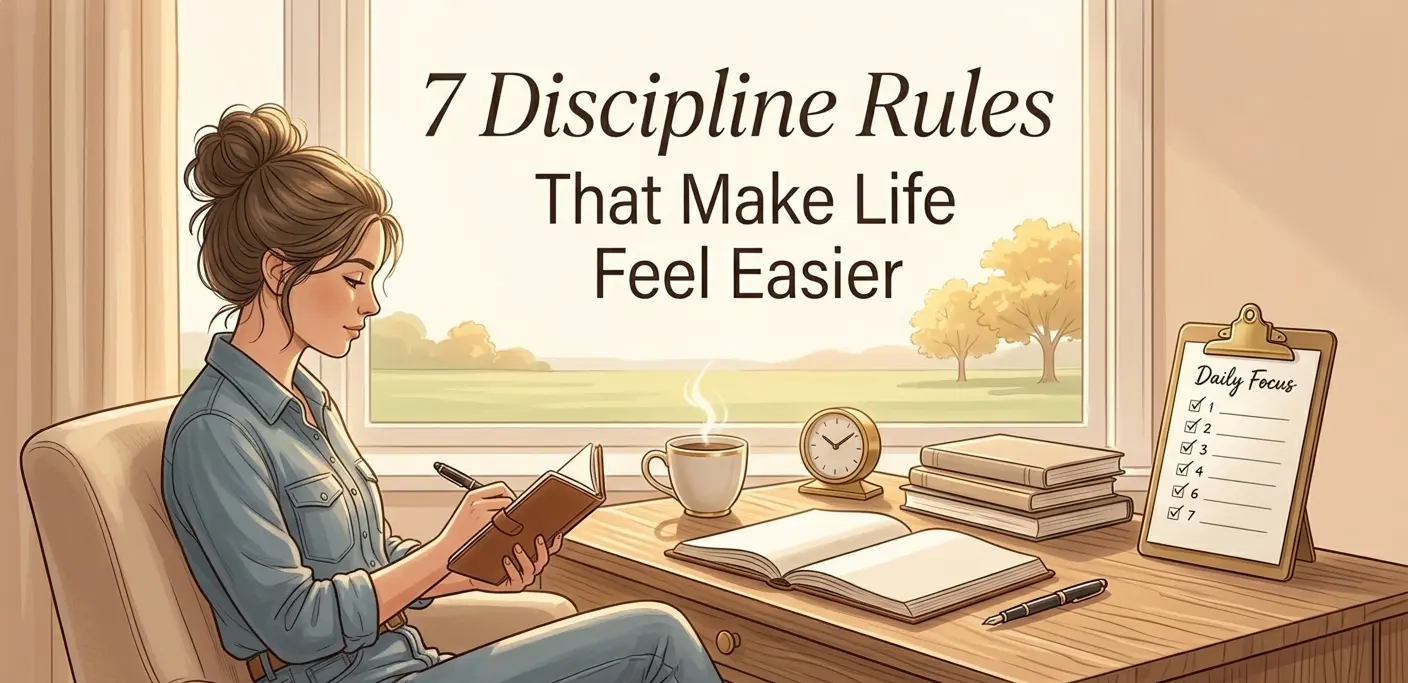
7 Discipline Rules That Actually Make Life Feel Easier (Not Harder)
Most people think discipline is about forcing yourself to do things you don’t want to do. White-knuckling through resistance. Pushing harder when everything in you wants to stop.
That’s not discipline. That’s exhaustion with a productivity label on it.
Real discipline, the kind that actually works over time,e is quieter than that. It’s structural. It removes friction, reduces decisions, and creates a life where the right things happen not because you summoned extraordinary willpower, but because you built conditions that made them inevitable. These 7 rules are what that looks like in practice.
Stop Relying on Motivation to Start
The Situation: You wait until you feel ready,dy until the mood is right, the energy is there, the resistance has softened. But the feeling rarely arrives on cue. And another day passes without the thing getting done.
The Lesson: Motivation follows action; it rarely precedes it.
The Insight: The belief that you need to feel motivated before you begin is one of the most reliable ways to ensure you never do. Action generates momentum, and momentum generates the feeling you were waiting for. The disciplined person doesn’t wait for the right emotional state; they start anyway and let the state catch up.
Example: A writer who waits for inspiration produces inconsistently. A writer who sits down at the same time every day, regardless of how they feel, produces a body of work. The first is at the mercy of their mood. The second has made mood irrelevant.
“Motivation is unreliable. Structure is what actually gets things done.”
“You don’t need to feel like it. You just need to start, the feeling comes after.”
Design Your Environment Before You Need Willpower
The Situation: You rely on willpower to resist distraction, avoid bad habits, and stay on task. And it works until it doesn’t. Until you’re tired, stressed, or depleted, and the path of least resistance wins every time.
The Lesson: Willpower is a limited resource; your environment is not.
The Insight: The most disciplined people are not the ones with the most self-control. They are the ones who have arranged their surroundings so that self-control is required as rarely as possible. Every temptation removed, every friction point added to a bad habit, and every good habit made easier is a small decision that pays forward indefinitely.
Example: If your phone is the first thing you reach for in the morning, the problem is not your willpower, but it is the phone’s location. Move it to another room before bed. The behavior changes not because you became more disciplined overnight, but because the environment stopped making the bad choice easier than the good one.
“The easiest way to be disciplined is to design a life where discipline is rarely required.”
“Don’t fight your environment. Build one that works for you instead of against you.”
Protect Your First Hour Like It Determines Everything — Because It Does
The Situation: You start most mornings reactively checking messages, scrolling, responding to what the world wants from you before you’ve had a single moment to yourself. And the rest of the day tends to feel like you never quite caught up.
The Lesson: The first hour of your day sets the cognitive and emotional tone for everything that follows.
The Insight: How you begin matters disproportionately. A morning spent in reaction trains your brain to operate in a reactive state, te scattered, responsive, and at the mercy of external input. A morning spent in even modest intentionality, movement, silence, clarity, and creation trains the opposite. You don’t need an elaborate routine. You need to own that first hour before anything else claims it.
Example: Keeping your phone in another room overnight is a structural choice that protects your morning by default. The people who check their phone within minutes of waking rarely describe their days as focused or self-directed. The correlation is not coincidental.
“The way you spend your first hour quietly programs the rest of your day.”
“Own your morning before the world decides how it goes.”
Make Decisions in Advance, Not in the Moment
The Situation: You make your worst choices when you’re tired, hungry, stressed, or depleted, when the immediate feels more real than the long-term,m and the effort of doing the right thing seems disproportionate to the reward.
The Lesson: Your future self makes worse decisions under pressure, re so make the important ones in advance, when you’re clear.
The Insight: This is what pre-commitment is the practice of deciding when you’re resourced, so you don’t have to decide again when you’re not. Meal prepping, scheduling workouts, and planning your week on Sunday are not just logistical tools. They are acts of self-trust. You are telling your depleted future self: you don’t have to figure this out right now. It’s already handled.
Example: Lying out workout clothes the night before seems trivial. But it removes a decision from a moment when resistance is highest, the morning, before momentum has built. That single removed decision increases follow-through significantly. The behavior didn’t change. The decision architecture did.
“Make the decision when you’re at your best. Your worst moments will thank you.”
“Pre-commitment is not restriction. It is the most compassionate thing you can do for your future self.”
Do the Hard Thing First, Before the Day Has a Chance to Object
The Situation: You tell yourself you’ll get to the important task later, after the emails, after the easier things, after you’ve warmed up. Later arrives, and it goes undone again. The important thing keeps losing to the urgent ones.
The Lesson: The task you keep avoiding will drain your energy all day,y whether you do it or not,t so do it first.
The Insight: Procrastination is not rest. Carrying an avoided task in the back of your mind while doing other things is its own form of cognitive load, low-grade, persistent, and exhausting. Doing the hard thing first doesn’t just get it done. It removes the weight of it from the rest of your day and generates a momentum that makes easier tasks easier.
Example: The professional who answers email first thing feels productive, but often ends the day without touching their most important work. The one who protects the first block of the workday for deep, focused effort, no email, no meeting,s consistently produces more of what actually matters. Sequence is not a small thing.
“The task you avoid all day costs you far more energy than the task you just do.”
“Do the hard thing first. Everything after it will feel easier by comparison.”
Measure Consistency, Not Perfection
The Situation: You miss one daof y one workout, one healthy meal, one productive morning, and something in you decides the whole effort is ruined. So you stop entirely, until the next time you feel motivated enough to start from scratch.
The Lesson: One missed day breaks nothing,g but the decision to quit after missing one day breaks everything.
The Insight: Perfectionism is one of the most effective disguises procrastination wears. It sets a standard that guarantees eventual failure, and then uses that failure as justification to stop. The only metric that actually matters over time is consistency, not perfect consistency, but persistent consistency. The person who shows up 80% of the time, without drama about the 20%, will always outperform the person who swings between perfection and abandonment.
Example: Missing one gym session is a blip. Deciding that missing it means you’ve failed and stopping for three weeks is a pattern. The rule that changes everything: never miss twice. One miss is an interruption. Two in a row is the beginning of a new habit,t the wrong one.
“You don’t need to be perfect. You just need to be consistent enough that imperfect days don’t end the whole thing.”
“One missed day is nothing. Quitting after one missed day is everything.”
Rest, Deliberate, ly or Your Body Will Force It.
The Situation: You treat rest as something you earn a reward for productivity, permitted only after everything is done. Since everything is never done, rest becomes something you fall into rather than something you choose.
The Lesson: Unplanned rest is recovery; planned rest is strategy.
The Insight: Discipline without recovery is not sustainable and,e it is depletion on a schedule. The body and mind require genuine downtime, not as a concession but as a functional requirement for continued output. The people who build rest into their routine deliberately, not as a sign of weakness but as a non-negotiable input, sustain their performance over time in ways that those running on fumes cannot.
Example: Elite athletes do not train hard every single day. Their rest days are as planned and as intentional as their training days because their coaches understand that adaptation happens during recovery, not during effort. The same principle applies to every area of sustained human performance. Rest is not the pause between productive periods. It is part of what makes them possible.
“Rest that you choose is recovery. Rest that your body forces is a consequence.”
“Discipline includes knowing when to stop. That part is not optional.”
A Final Thought
Discipline, properly understood, is not about being hard on yourself. It is about being honest with yourself about what you want, what it actually requires, and whether the way you’re spending your days is moving you toward it or away from it.
The rules in this post are not about perfection or punishment. They are about building a life where the things that matter to you happen with less friction and more consistency,y not because you forced them, but because you built conditions that made them easier to choose.
Start with one. The smallest, most practical one that you can apply today. That is always enough to begin.