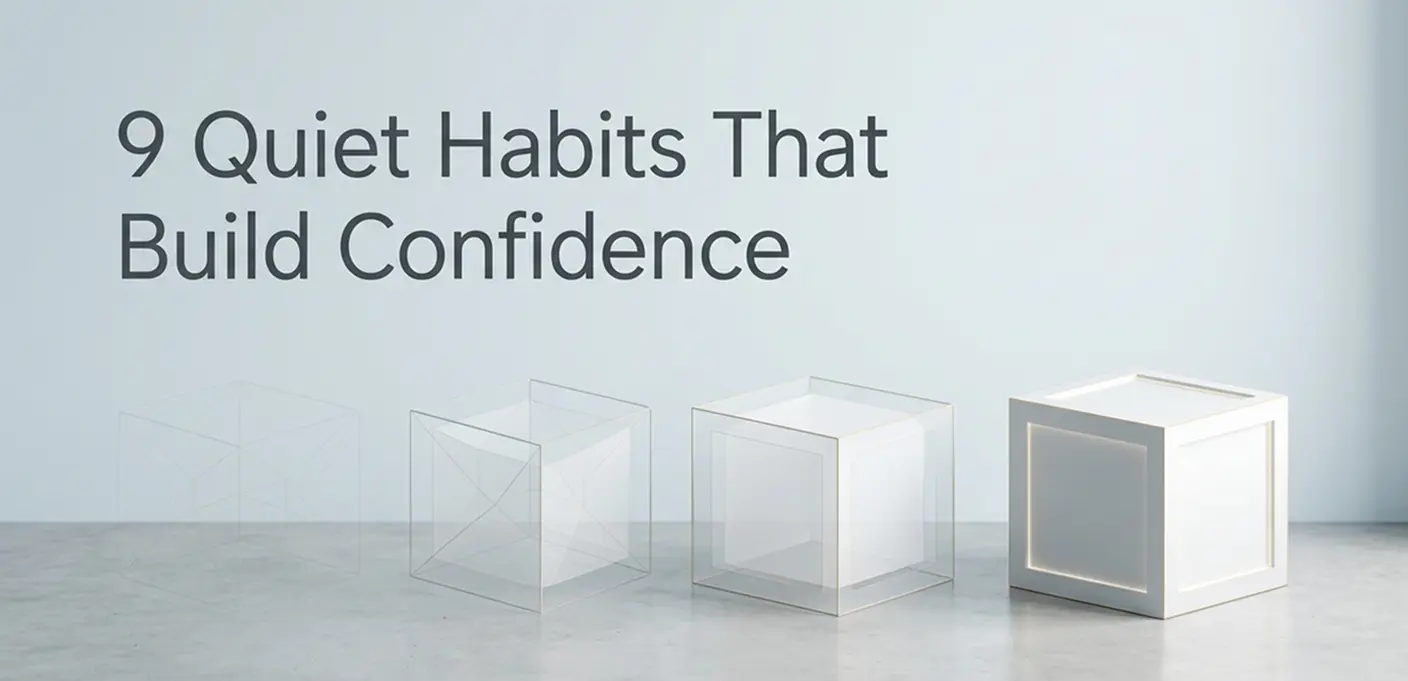
9 Quiet Habits That Build Confidence Without You Even Noticing
Most confidence advice tells you to do more speak up more, push harder, and fake it until you make it. But the most durable confidence isn’t built through performance. It’s built through small, consistent habits that quietly reshape how you relate to yourself over time.
The people who carry genuine confidence rarely arrive there through a single breakthrough. They arrived through accumulated small choices, things they stopped doing, things they started noticing, ways they began treating themselves differently without announcing it to anyone. It happened so gradually they almost didn’t notice. Until one day, the self-doubt that used to be constant was simply… quieter.
These 9 lessons are how that happens.
When You Stop Apologizing for Taking Up Space
The Situation: You apologize before sharing an opinion. You shrink in rooms where you feel uncertain. You qualify everything you say with “I might be wrong, but…” before anyone has questioned you.
The Lesson: Every unnecessary apology is a small signal to yourself that your presence requires justification, and those signals accumulate.
The Insight: The habit of pre-emptive apology is not politeness. It is a pattern of communicating to yourself as much as to others that your thoughts, presence, and needs are a potential imposition. Removing it does not make you less considerate. It makes you more honest. And the simple act of speaking without a disclaimer begins to shift how you carry yourself in every room.
The Takeaway: For one week, notice every time you apologize unnecessarily. Don’t force a change, just observe the frequency. Awareness alone begins to loosen the habit, and the confidence that quietly builds from removing it is disproportionate to the effort.
“Every unnecessary apology teaches you that your presence needs permission. It doesn’t.”
“Speak without the disclaimer. Your thoughts deserve to arrive without an apology attached.”
When You Start Keeping Promises to Yourself
The Situation: You commit to something as a habit, a boundary, or a small goal and don’t follow through. It happens enough that somewhere underneath everything, you’ve stopped fully believing yourself when you say you’ll do something.
The Lesson: Self-trust is the foundation of confidence, and it is built or eroded by how consistently you keep the promises you make to yourself.
The Insight: Every broken self-commitment sends a quiet signal: your word to yourself doesn’t fully count. Over time, this erodes not just follow-through but belief in your own capability. The reverse is equally true: every kept promise, however small, deposits something into your self-trust. Not through grand effort, but through the pattern of doing what you said you’d do.
The Takeaway: Make smaller commitments. Not easier ones, smaller ones. The goal is a promise you will actually keep. One kept commitment daily builds more genuine confidence than ten broken resolutions ever could.
“The most important promises you make are the ones you make to yourself.”
“Self-trust isn’t found. It’s built, one kept commitment at a time.”
When You Stop Seeking Validation Before Acting
The Situation: Before you move forward on something, you need someone to confirm it’s a good idea. Not for information or permission. The decision is already made internally, but it doesn’t feel safe until someone else approves it.
The Lesson: Every time you outsource a decision to someone else’s approval, you practice not trusting yourself, and that practice compounds.
The Insight: Seeking input is valuable. Seeking validation is different; it transfers the authority over your own choices to someone else, and over time, their approval becomes more necessary, not less. The habit of checking in with your own judgment first, even briefly, even imperfectly rebuilds the self-trust that validation-seeking quietly dismantles.
The Takeaway: Before asking anyone else for input on your next decision, write down your own read first. What do you actually think? What does your instinct say? Then seek an outside perspective if you still need it. Starting with yourself every time is the practice.
“Every time you wait for someone else’s approval, you practice not trusting yourself.”
“Your instincts have been right more often than you’ve acknowledged. Start there.”
When You Acknowledge What You’ve Already Done
The Situation: Your mind reliably minimizes what you’ve accomplished and amplifies what you haven’t. The hard things you’ve done fade quickly. The gaps feel enormous and permanent.
The Lesson: Confidence requires evidence, and evidence requires you to actively notice and retain it rather than letting it disappear.
The Insight: The brain’s negativity bias means failures register more strongly and linger longer than successes without deliberate intervention. Building genuine confidence means correcting that imbalance by deliberately cataloging proof of your capability. This is not arrogance. It is an accurate accounting of a ledger that is structurally skewed against you by default.
The Takeaway: Write down five things you’ve done that were genuinely hard. Keep the list. Add to it. On the days when doubt is loudest, read it before responding to it. Your own evidence is more relevant to your actual capability than any feeling of inadequacy that arrived without data.
“Your confidence has more to stand on than you’re giving it credit for.”
“The hard things you’ve already done are proof of what you’re capable of. Don’t let them disappear.”
When You Stay in a Room That Makes You Uncomfortable
The Situation: The situation is unfamiliar, the conversation, the environment, and the group. Every instinct says to leave or shrink. You stay. You don’t perform well, but you stay.
The Lesson: Confidence expands at the edges of discomfort and stagnates at the center of comfort, and staying in the uncomfortable room is the whole exercise.
The Insight: Avoidance is confidence’s most reliable enemy. Every situation sidestepped because it felt exposing reinforces the belief that you can’t handle it. Every situation, stayed in however awkwardly, however imperfectly, deposits the opposite evidence. The goal is not to perform well in uncomfortable spaces. It is to survive them repeatedly until survival becomes the baseline.
The Takeaway: This week, stay in one uncomfortable situation for slightly longer than your instinct says to. Don’t perform, just remain present. The evidence that you can tolerate discomfort is more valuable to your confidence than any amount of performing well in safe ones.
“Confidence isn’t built in comfortable rooms. It’s built at the edges of them.”
“You don’t need to do it well. You just need to stay long enough to learn you can.”
When You Stop Explaining Yourself to People Who Weren’t Asking
The Situation: You over-explain your choices, your schedule, your preferences, your decisions. Not because anyone asked for justification, but because you’re preemptively defending yourself against judgment that may not even exist.
The Lesson: Over-explanation signals insecurity, and the habit of removing it gradually shifts how you carry both your decisions and yourself.
The Insight: The need to justify your choices to people who didn’t ask comes from the same place as unnecessary apologizing, the belief that your decisions require external ratification to be valid. They don’t. A choice made and stated plainly, without a supporting argument, communicates something different than the same choice delivered with an anxious footnote. Practice the plain version.
The Takeaway: Notice when you’re explaining something that no one questioned. Then practice ending the sentence one step earlier, the decision without the defense. The discomfort of that brevity is precisely what the habit needs to be interrupted.
“You don’t owe anyone an explanation for a choice they didn’t question.”
“State the decision. Leave the defense for when it’s actually needed.”
When You Speak at Normal Volume About Normal Things
The Situation: You trail off at the end of sentences. You preface ideas with “this is probably wrong, but…” You make yourself smaller in conversations before anyone has asked you to be.
The Lesson: The physical way you occupy space and deliver words communicates your self-assessment before the content does, and both the room and your nervous system receive the message.
The Insight: Voice, posture, and eye contact are not just social signals; they feed back into your own sense of self. The research on embodied cognition consistently shows that how you physically carry yourself affects how you feel about yourself, not just how others perceive you. Small adjustments, finishing sentences, maintaining eye contact, and taking up your actual amount of space quietly shift both.
The Takeaway: Pick one physical habit to adjust this week. Finish every sentence at full volume. Don’t qualify the last word. The change feels disproportionately significant both to you and to the room, and that significance is the confidence being built in real time.
“Your body communicates your self-assessment before you say a word. Make sure it’s accurate.”
“Finish the sentence. Take up your actual amount of space. Both matter more than you think.”
When You Let a Compliment Land
The Situation: Someone says something genuinely positive about you or your work. Your immediate response is to deflect, minimize, or redirect. The compliment never actually reaches you.
The Lesson: Deflecting positive feedback is not humility; it is a trained refusal to receive evidence that contradicts your self-doubt.
The Insight: Every deflected compliment is a piece of evidence discarded before it could update your self-assessment. Over time, positive feedback that is consistently dismissed stops registering, and the internal narrative, fed only by what gets through, skews toward the critical. Receiving a compliment, simply a thank you without a disclaimer, is not arrogance. It is the practice of letting accurate positive information actually land.
The Takeaway: The next time someone says something genuinely positive, try responding with only “thank you”, nothing minimizing, nothing redirected. Sit with the discomfort of receiving it fully. That discomfort is the old habit being interrupted, and the interruption is the practice.
“Deflecting a compliment isn’t modesty. It’s discarding evidence that could change how you see yourself.”
“Let the good things people say about you actually land. You’re allowed to receive them.”
When You Do the Hard Thing Without Announcing It
The Situation: You do something difficult, face something uncomfortable, make the hard call, follow through when it would have been easy not to. Nobody notices. You notice.
The Lesson: Confidence built in private through actions witnessed only by yourself is the most durable kind available.
The Insight: The confidence that depends on external recognition is only as stable as the recognition lasts. The confidence built through private integrity, doing the right thing, keeping the commitment, and facing the fear when no one is watching accumulates into something that doesn’t require validation to remain. You become the reliable witness to your own capability, and that relationship with yourself is the most stable foundation of confidence can have.
The Takeaway: The next time you do something hard that no one sees, take a moment to acknowledge it honestly, not performatively, just privately. You showed up. That counts. The habit of registering your own integrity is the habit that builds the most lasting confidence available.
“The confidence no one else sees you building is the most solid kind.”
“Private integrity doing the right thing when no one is watching is where real confidence lives.”
A Final Thought
Confidence is not a personality trait you either have or don’t. It is a relationship with yourself shaped quietly, through small habits practiced in ordinary moments that most people never identify as significant.
You don’t need a dramatic transformation. You need the consistent accumulation of small choices that tell you, repeatedly, that you can be trusted, that your presence matters, and that the evidence for your capability is more substantial than your doubt has been willing to admit.
Start with one. The smallest, most available one. And let it do its quiet work.