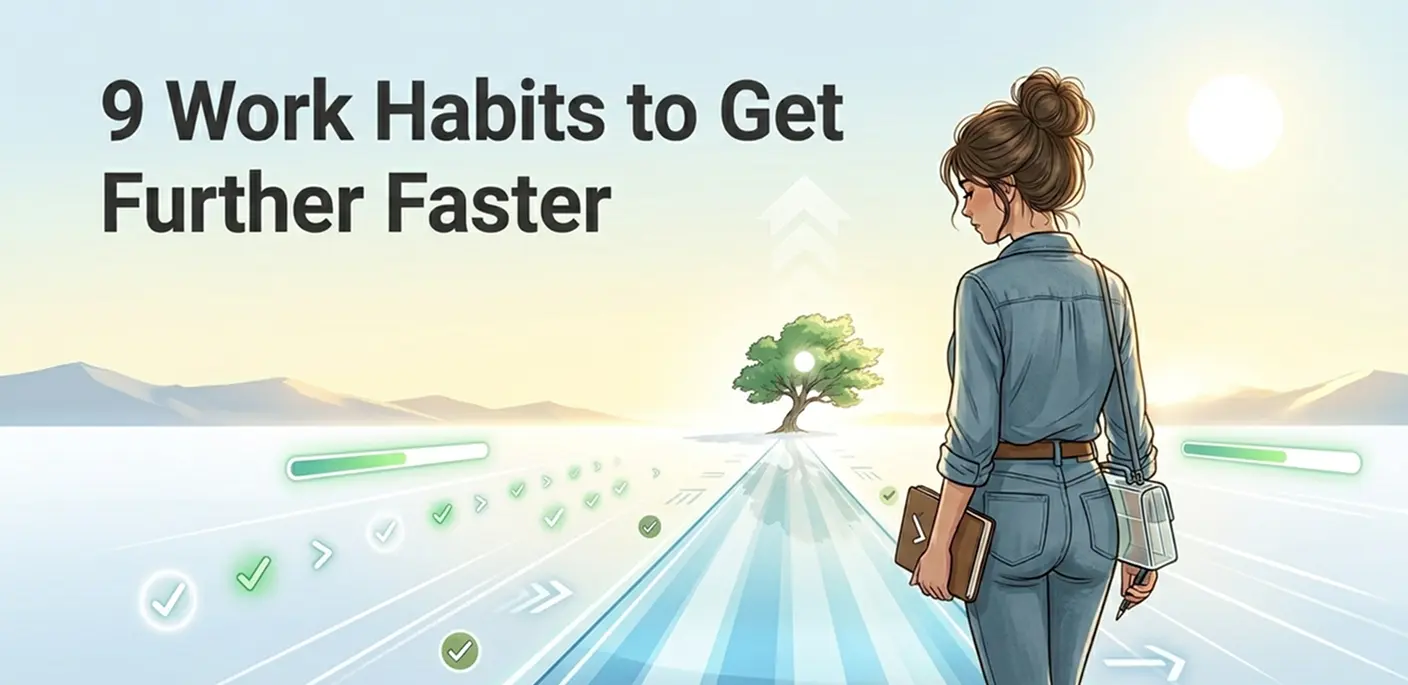
9 Work Habits That Help You Move Further in Less Time
Most people don’t need to work more hours. They need to work differently with the ones they already have.
The gap between people who seem to make consistent, visible progress and those who feel perpetually stuck is rarely about talent, resources, or even effort. It is almost always about habits, the small, structural choices that determine how energy gets directed, how focus gets protected, and how much of each day actually converts into meaningful output.
These 9 habits won’t ask you to grind harder. They’ll ask you to work smarter, more deliberately, and with a clearer understanding of what actually moves things forward.
Starting Each Day With a Single Clear Priority
The Situation: You begin the day with a vague intention to “be productive” and end it having done a lot without having advanced the thing that actually matters most. The day felt full. The needle barely moved.
The Lesson: Without a defined priority, everything feels equally urgent,t and nothing gets the depth of attention it deserves.
The Insight: The mind works best when it has a clear target. When every task competes equally for attention, the result is shallow engagement across many things instead of meaningful progress on the right one. One clear priority identified before the day begins acts as an anchor that keeps the most important work from being crowded out by the merely urgent.
Benefit: You end more days feeling genuinely accomplished rather than just busy. Over weeks and months, the compound effect of consistently advancing your most important work creates results that scattered effort simply cannot produce.
“The day that begins without a clear priority usually ends without a real one either.”
“One thing done deeply matters more than ten things done halfway.”
Protecting a Block of Time for Deep, Uninterrupted Work
The Situation: Your workday is fragmented by meetings, messages, interruptions, and context-switching. By the time you sit down to do the work that requires real thinking, the best of your cognitive energy is already gone.
The Lesson: Deep work, the kind that produces meaningful output,t requires uninterrupted time that most people never deliberately protect.
The Insight: Cognitive focus is not a tap you can turn on and off without cost. Every interruption, even a brief one,e requires a recovery period before full concentration returns. A single two-hour block of protected, distraction-free work consistently produces more than a full day of fragmented effort. The people who understand this guard that block like it is the most valuable asset in their schedule because it is.
Benefit: Work that used to take all day begins to take a fraction of the time. Not because you’re rushing, but because focused attention is exponentially more efficient than divided attention. You produce more, think more clearly, and experience less end-of-day exhaustion.
“Two hours of focused work will almost always outperform eight hours of distracted effort.”
“Your best thinking requires the kind of quiet most people never give themselves.”
Closing Loops Before They Accumulate
The Situation: Small unfinished things pile up in the email you didn’t reply to, the decision you deferred, the task you half-completed. Individually, they seem minor. Collectively,y they create a low-grade mental burden that never quite goes away.
The Lesson: Open loops don’t just sit in your to-do list; st they sit in your mind, consuming background attention whether you’re aware of it or not.
The Insight: Every unresolved task or uncommitted decision occupies a small portion of your cognitive bandwidth. The accumulation of these open loops is one of the most underestimated sources of mental fatigue and reduced focus. Closing them decisively and completely frees up that bandwidth for the work that actually requires it.
Benefit: A mind with fewer open loops is a mind that thinks more clearly, focuses more easily, and experiences less of the diffuse anxiety that comes from feeling perpetually behind. The relief of a genuinely clear mental slate is both immediate and compounding.
“Unfinished tasks don’t wait quietly. They follow you everywhere until you close them.”
“A clear to-do list and a clear mind are the same thing. Treat them accordingly.”
Batching Similar Tasks to Protect Your Focus
The Situation: You switch between different types of work throughout the day, emails, then creative work, then administrative tasks, then back to emails. Each switch feels small. The cumulative cost to your focus is significant.
The Lesson: Every time you switch between different types of tasks, your brain pays a transition cost and those costs add up faster than most people realize.
The Insight: Batching grouping similar tasks and doing them together in a dedicated block eliminates the constant cognitive overhead of switching modes. Answering all emails at once, making all calls in sequence, handling all administrative work in a single sitting, each of these preserves the mental momentum that task-switching quietly destroys.
Benefit: You move through your workload with noticeably less friction and fatigue. Tasks that feel tedious in isolation feel more manageable in batches. And the work that requires your best thinking gets it because you’ve stopped fragmenting your attention across the day.
“Every time you switch tasks, you pay a focus tax. Batching is how you stop paying it repeatedly.”
“Protect your modes of thinking the same way you protect your time.”
Making Decisions Quickly on Low-Stakes Matters
The Situation: You spend disproportionate time and energy on decisions that, in the long run, don’t significantly matter. The meeting time, the email wording, and the minor logistical choice. Each one feels worth considering carefully, and each one quietly drains the decision-making capacity you need for things that actually do matter.
The Lesson: Decision fatigue is real, and it is most often caused by the decisions that deserve the least attention.
The Insight: Research on decision fatigue consistently shows that the quality of decision-making degrades with each choice made, regardless of the importance of the choice. Reserving your cognitive resources for high-stakes decisions means ruthlessly reducing the time spent on low-stakes ones. Good enough, chosen quickly, is almost always the right answer for minor decisions.
Benefit: You arrive at the decisions that matter with more clarity, more patience, and more mental bandwidth. You stop ending days feeling drained by a hundred small choices and start using that energy where it actually produces results.
“Not every decision deserves deliberation. Saving your best thinking for what matters is a skill.”
“Decide quickly on small things so you can think deeply about the important ones.”
Ending Each Day With a Brief Review and Reset
The Situation: You finish work and immediately move into the evening without capturing what happened, what’s outstanding, or what tomorrow needs to look like. The next morning begins with a few minutes of reorientation that slowly become the new normal.
The Lesson: Five minutes of intentional closing at the end of the day saves thirty minutes of reorientation at the start of the next one.
The Insight: A brief end-of-day review what got done, what didn’t, and what tomorrow’s priority is serves two purposes. It closes the mental loops of the day so your mind can genuinely rest in the evening. And it means you begin the next morning with direction already established, rather than rebuilding it from scratch while your best cognitive energy ticks away.
Benefit: Evenings become more genuinely restful because your mind isn’t running through incomplete tasks. Mornings become more immediately productive because the first decision of the day was already made the night before. The transition between work and rest becomes cleaner in both directions.
“The five minutes you spend closing the day properly are worth more than the first thirty minutes of the next one.”
“A good tomorrow starts with how you end today.”
Saying No to Commitments That Don’t Serve the Work
The Situation: Your calendar fills with meetings, requests, and obligations that each seems reasonable in isolation. But together, they leave almost no time for the work that actually moves your goals forward. You’re serving everyone else’s priorities while yours wait.
The Lesson: Every commitment you accept is a commitment to something else you cannot do, and that trade is rarely made consciously enough.
The Insight: Time is the one resource that cannot be recovered. Every yes to something low-value is a no to something high-value,e whether or not you frame it that way. The most productive people are not the most available ones. They are the ones who have become genuinely selective about where their time goes, and are comfortable with the temporary discomfort of declining what doesn’t serve the work.
Benefit: When your time is protected, the work that matters gets the hours it deserves. The quality of your output increases not because you’re working harder but because you’ve stopped diluting your energy across commitments that weren’t worth it in the first place.
“Every yes is a trade. Make sure you know what you’re trading every time you make one.”
“The most productive word in your vocabulary might be a well-placed no.”
Building a Consistent Start Ritual That Signals Focus
The Situation: You sit down to work, but spend the first fifteen minutes drifting,g checking messages, opening tabs, adjusting the playlist. The work hasn’t started. The session has already been partially wasted.
The Lesson: A consistent start ritual trains your brain to enter a focused state faster and more reliably than willpower alone ever could.
The Insight: The brain responds to environmental and behavioral cues. Thisis is the same mechanism behind habit formation. A short, consistent sequence of actions before work begins, the same sequence, in the same order, every time, becomes a reliable on-ramp to focused attention. It doesn’t have to be elaborate. It has to be consistent.
Benefit: You waste less of every session on the ramp-up phase. Over time, the ritual itself becomes the trigger,r and focus arrives faster, more automatically, and with less internal negotiation than it did before the ritual existed.
“A consistent start ritual isn’t a productivity trick. It’s a signal your brain learns to trust.”
“The way you begin your work shapes everything that follows it.”
Reviewing What’s Working — and Cutting What Isn’t
The Situation: You continue doing things the same way out of habit the same workflow, the same tools, the same approach without ever pausing to ask whether they’re actually producing the results you want. Effort continues. Efficiency stagnates.
The Lesson: Without periodic review, you optimize for the feeling of working rather than the outcome of it.
The Insight: A brief weekly or monthly review of what produced results, what didn’t, and what should change is one of the highest-leverage habits available to anyone doing serious work. It prevents the accumulation of low-value activities that expand to fill available time without anyone consciously choosing them. It keeps the work honest, the systems current, and the direction aligned with the actual goal.
Benefit: You spend progressively more time on what works and less on what doesn’t, not because you worked harder, but because you looked honestly at the evidence and adjusted accordingly. Over time, this compounds into a significantly more efficient and intentional way of working.
“Effort without reflection is how you get very good at doing the wrong things.”
“Review regularly. The work that survives scrutiny is the work worth keeping.”
A Final Thought
Working faster isn’t really the goal. Working in a way that consistently produces meaningful results without burning through the person doing the work is the goal.
These habits are not about squeezing more output from the same hours. They are about removing the friction, distraction, and inefficiency that quietly prevent good work from happening at the pace it could.
Start with the one habit that addresses the problem costing you the most right now. Build it until it becomes automatic. Then add the next one.
That is always how sustainable progress is built quietly, consistently, one good habit at a time.