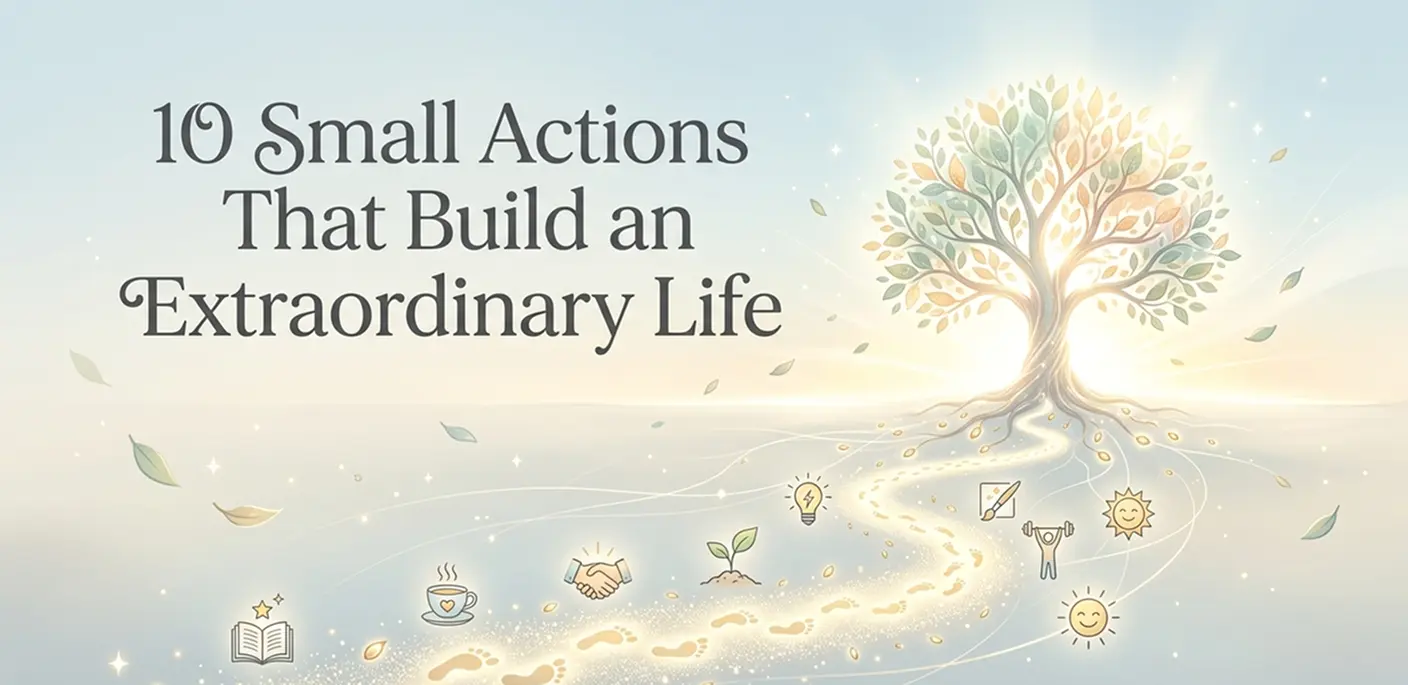
10 Small Daily Actions That Quietly Build an Extraordinary Life
Nobody notices the day the river starts carving the canyon. The water just keeps moving consistently, in the same direction, and the result accumulates invisibly until one day the landscape has completely changed.
That is exactly how the most significant improvements in a person’s life actually happen. Not through dramatic overhauls or breakthrough moments, but through small actions repeated daily until their compound effect becomes undeniable. The problem is that compounding is invisible in the short term,m which makes it easy to underestimate, dismiss, and abandon before it has a chance to work.
These 10 daily actions are not impressive on their own. Done once, none of them will change your life. Done consistently, over months and years, they will change it entirely.
Reading for Twenty Minutes Every Day
The Situation: Twenty minutes feels like almost nothing, ng too small to matter, too brief to produce anything meaningful. So most people don’t bother, or replace it with something that requires less of them.
The Lesson: Twenty minutes of reading daily compounds into a genuinely different mind over time, one with broader knowledge, sharper thinking, and a wider frame of reference for every decision you make.
The Insight: Twenty minutes a day is roughly 18 books a year. Over a decade, that is 180 books, is the equivalent of a self-directed education in whatever subjects you choose. The person who reads consistently does not just know more. They think differently, as they have access to more frameworks, more perspectives, and more solutions than someone operating exclusively from personal experience.
The Result: Decisions improve because your reference pool expands. Problems become more solvable because you’ve encountered their patterns before, in different forms. The knowledge compounds silently, and then suddenly, noticeably, you are someone who sees things others miss.
“The person you’ll be in five years is largely determined by the books you read and the ideas you expose yourself to.”
“Twenty minutes a day doesn’t feel like much until you calculate what it becomes.”
Moving Your Body Without Waiting to Feel Like It
The Situation: You tell yourself you’ll exercise when you have more energy, not realizing that the energy you’re waiting for is produced by the very movement you’re avoiding.
The Lesson: Daily movement is not primarily about physical appearance, but it is the single most reliable way to regulate energy, mood, and cognitive clarity consistently.
The Insight: Exercise is one of the few interventions that simultaneously improves mental health, physical health, cognitive function, and long-term resilience. It does not require intensity or duration to produce these effects; it requires consistency. Thirty minutes of walking produces measurable benefits that a once-weekly intense workout cannot replicate. Regularity is the mechanism. Everything else is detail.
The Result: Energy levels stabilize. Mental clarity improves. The low-grade fatigue and mood instability that many people accept as normal begin to lift. Over time, the compounded effect of daily movement shows up not just physically but in the quality of your thinking, your work, and your emotional steadiness.
“The energy you’re waiting for is created by the movement you keep postponing.”
“You don’t exercise to look different. You exercise to think, feel, and function differently, every single day.”
Writing Down Three Priorities Before the Day Begins
The Situation: Most days begin with reactively responding to messages, following the urgency of others, filling hours without directing them. The day ends with activity but without meaningful progress on anything that actually matters.
The Lesson: A day without defined priorities is a day that gets decided by everyone and everything except you.
The Insight: Three priorities, not ten, not a comprehensive list, but three create just enough structure to anchor the day without the rigidity that makes planning feel oppressive. This small act of intention before the day begins is the difference between a day that happens to you and a day you shape. It takes two minutes. Its effect on the quality of the following eight hours is disproportionate to that investment.
The Result: Weeks accumulate with direction instead of drift. The important projects are actually advancing. And at the end of each day, there is a clear, measurable answer to the question: Did I do what mattered? Over time, this daily clarity compounds into a life that reflects your actual priorities rather than everyone else’s.
“The day you don’t plan gets planned for you, usually by whoever needs something.”
“Three clear priorities before 9am changes what the rest of the day becomes.”
Drinking Water Before Anything Else in the Morning
The Situation: It sounds almost too simple to include. Which is exactly why most people skip it, reaching for coffee, for the phone, for anything more stimulating than a glass of water before their body has had what it actually needs first.
The Lesson: Hydration is not a wellness trend;d it is a foundational input that affects cognitive function, energy, and mood from the first hour of the day forward.
The Insight: After six to eight hours without fluids, the body wakes in a state of mild dehydration that affects concentration, mood regulation, and physical energy, which often occurs before any of these deficits are consciously noticed. Starting the day with water before caffeine is a small structural choice that costs nothing and produces a measurably different first hour than its alternative.
The Result: Compounded across months and years, starting each day properly hydrated supports better cognitive performance, more stable energy, and fewer afternoon crashes. It is not a dramatic intervention. It is a foundational one, the kind that makes everything built on top of it more reliable.
“The simplest habits are the ones most underestimated. And the most underestimated ones are often the most foundational.”
“How you treat your body in the first thirty minutes of the day quietly shapes the next twelve hours.”
Doing One Thing That Makes Tomorrow Easier
The Situation: You end the day depleted, leaving tomorrow’s version of yourself with the same mess, the same ambiguity, and the same standing start that made today harder than it needed to be.
The Lesson: Five minutes of preparation today is worth thirty minutes of reorientation tomorrow,w and it is a gift your future self receives every single morning.
The Insight: This can be as simple as laying out workout clothes, writing tomorrow’s three priorities, clearing the workspace, or sending the email that would otherwise hang overhead. The specific action matters less than the habit of closing the day with one forward-facing gesture. It signals to your mind that the day is genuinely finished, and it gives tomorrow a running start.
The Result: Mornings become more immediately focused. The low-grade anxiety of waking up to unresolved loose ends decreases. Over time, the habit of preparing for tomorrow builds a kind of daily momentum each day, landing more smoothly than the last because the previous one was closed with intention.
“The kindest thing you can do for tomorrow’s version of yourself is take five minutes tonight.”
“Preparation is not a luxury. It’s the thing that makes the next day feel possible before it starts.”
Practicing One Minute of Deliberate Stillness
The Situation: The day moves from one input to the next without pause,e notifications, conversations, tasks, decisions, ns until the mind is running at a pace that makes clear thinking nearly impossible, and you’ve forgotten what your own thoughts actually sound like.
The Lesson: One minute of genuine stillness, with no input, no output, no task, is enough to interrupt the accumulation of mental noise and return a baseline of clarity.
The Insight: This is not meditation in any elaborate sense. It is simply a deliberate pause, one minute of sitting quietly, breathing, and not consuming or producing anything. The mind, given even this brief window, begins to settle. What felt urgent becomes proportional. What felt unclear begins to sharpen. The effect is modest in isolation and significant in repetition.
The Result: A daily practice of stillness, even minima,l builds a quiet but durable capacity for self-regulation. Over time, you become less reactive, more present, and better able to respond thoughtfully to the moments that would otherwise pull you into automatic reaction. The pause gets easier. The clarity arrives faster. And the day feels less like something happening to you.
“One minute of stillness is not a spiritual practice. It’s a cognitive reset that costs nothing and pays forward.”
“The mind that gets no rest produces noisier thinking. Give it even one minute. It matters.”
Saying One Honest Thing You Would Have Softened
The Situation: You leave conversations having said the agreeable version instead of the honest one, protecting the moment at the cost of the relationship’s depth, or your own integrity. Over time, the unsaid things accumulate.
The Lesson: Small daily honesty builds the kind of trust in yourself and with others that no amount of agreeable behavior can produce.
The Insight: This is not about confrontation or bluntness. It is about the small, habitual choice to say what you actually think rather than what is most comfortable to say. In low-stakes situations, this builds the muscle. In higher-stakes ones, you have the capacity to use it. The compounded effect of daily small honesty is a life and relationships built on something real rather than something performed.
The Result: Self-respect deepens. Relationships become more genuine. The internal friction of carrying unexpressed truth decreases. And over time, you become someone others trust completely,y not because you’re always agreeable, but because what you say can always be believed.
“The small honest thing you keep softening is quietly costing you more than you realize.”
“Trust is built in small moments of honesty, not in grand declarations of it.”
Acknowledging One Thing That Went Well
The Situation: The day ends, ds and the mind immediately fills the gaps, the mistakes, the things undone. The things that worked go unregistered. And you carry forward a running account that is systematically biased toward what went wrong.
The Lesson: What you consistently notice shapes what you believe is true, and a mind trained to notice only failure becomes very good at finding it.
The Insight: This is not toxic positivity. It is cognitive accuracy. The brain’s negativity bias means that without deliberate intervention, failures are weighted more heavily than successes,s regardless of the actual ratio. One daily acknowledgment of what went well is not about ignoring problems. It is about correcting a systematic bias that, left unchecked, produces a distorted and consistently discouraging account of your own life.
The Result: Over time, the habit of noticing what works builds a more accurate and more resilient self-perception. Confidence becomes better calibrated. Motivation becomes more self-sustaining. And the evidence you use to assess your progress becomes more honest than the unfiltered bias your brain would generate on its own.
“What you consistently look for, you consistently find. Train your attention accordingly.”
“Noticing what went well isn’t optimism. It’s accuracy, the brain’s default setting is not.”
Learning One New Thing Intentionally
The Situation: Most information absorbed daily is reactive news, notifications, and content that arrives without being chosen. It fills the mind without expanding it in any direction you’ve actually decided to go.
The Lesson: One deliberately chosen piece of learning per day, accumulated over years, builds a knowledge base that passive consumption never could.
The Insight: Intentional learning does not require hours or formal study. It requires direction, a subject chosen, a question pursued, and a concept explored with the specific intention of understanding it better than you did yesterday. The distinction between intentional and passive consumption is not the amount of time spent. It is whether the input was chosen for a reason and retained with purpose.
The Result: Expertise develops. Curiosity compounds. Over the ears, the person who learns one intentional thing daily becomes someone with a genuinely unusual depth of knowledge in the areas that matter to them, not because they studied harder than others, but because they studied more consistently and more deliberately.
“Passive consumption fills time. Intentional learning builds something.”
“One deliberate thing learned daily becomes something remarkable in five years. Do the math.”
Ending the Day Without a Screen for the Last Thirty Minutes
The Situation: The last thing your mind absorbs before sleep shapes the quality of your rest, and most people are feeding it news, social media, or stimulating content right up until the moment they close their eyes.
The Lesson: The final thirty minutes of the day are disproportionately influential on sleep quality, on the emotional tone carried into rest, and on what the mind processes overnight.
The Insight: Screen use before sleep suppresses melatonin, delays sleep onset, and elevates cortisol,l the combination of which reduces sleep quality measurably, regardless of total hours slept. Beyond the physiological, the content consumed last has a way of lingering, ng the anxious scroll, the unresolved comment, the headline that shouldn’t have been the last thing considered before sleep. Replacing it with anything quiet, such as reading, conversation, or stillness, changes what the night produces.
The Result: Sleep deepens. The morning arrives with less residue from the night before. Over time, the accumulated benefit of consistently better rest shows up in every dimension of daily performance, cognitive clarity, emotional regulation, physical energy, and the capacity to do all nine of the other things on this list with greater consistency and less resistance.
“The last thirty minutes of your day are a quiet investment in how the next one begins.”
“What you feed your mind before sleep is what it works with overnight. Choose accordingly.”
A Final Thought
None of these actions will change your life today. That is precisely the point and precisely why they work.
The life that most people want is not built in grand gestures or perfect weeks. It is built in the ordinary moments, the small choices made consistently, without fanfare, long before the results are visible enough to feel like confirmation that they’re working.
Pick two of these. Not ten two. The ones that would make the most difference if practiced every day for the next six months. Start there. Let them become automatic before you add anything else.
That is how compounding works. And it has never once failed to produce something worth having.