How to Stay Focused When Everything Is Designed to Pull You Away
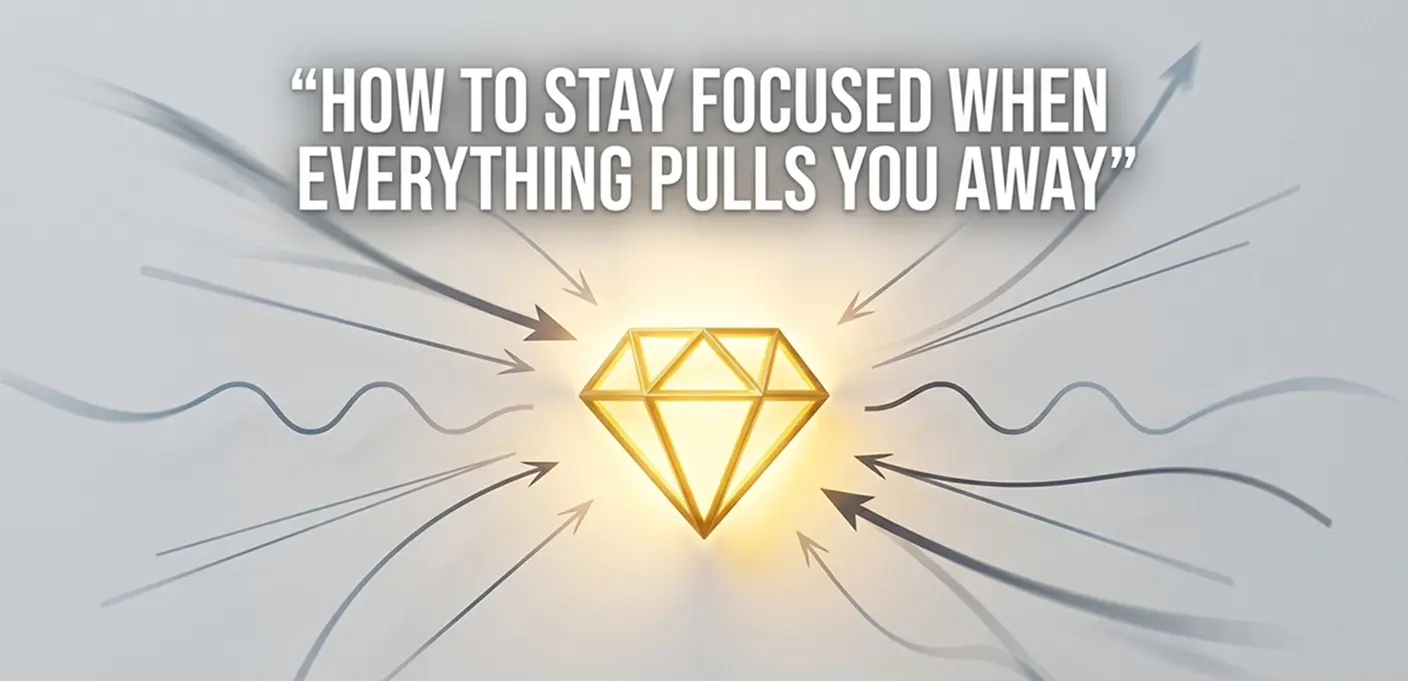
Distraction is no longer accidental. It is engineered.
The apps on your phone, the platforms you scroll, the notifications that interrupt you dozens of times a day, none of this is random. It is the output of entire industries whose business model depends on capturing and holding your attention as long as possible. You are not failing at focus. You are up against a system specifically designed to make focus difficult.
That context matters because the solution is not simply to try harder or want it more. The solution is to become deliberate about attention in a world that has made attention its primary resource to extract. These principles are what that looks like in practice.
Understand That Focus Is a Resource, Not a Character Trait
The Situation: You sit down to work and find yourself reaching for your phone before a sentence is written. You interpret this as laziness, weakness, or lack of willpower. The self-judgment makes it harder, not easier, to try again.
The Lesson: Focus is a finite cognitive resource that depletes with use and restores with rest. Treating it as a moral failing guarantees you’ll manage it poorly.
The Insight: Willpower and attentional control share the same neural resources that are genuinely limited and genuinely exhaustible. Understanding this changes the strategy entirely. The goal is not to demand more focus through sheer determination. It is to manage your attentional resources intelligently, protecting them when they’re high, conserving them when they’re low, and restoring them through genuine rest rather than passive consumption.
The Tip: Schedule your most focus-intensive work for the time of day when your attention is naturally highest typically within the first few hours of being awake for most people. Protect that window aggressively. Everything that requires less cognitive depth can fill the rest of the day.
“Focus is not unlimited. Manage it like the finite resource it is.”
“The question is not why you can’t focus. It’s whether you’re asking for focus when you actually have it.”
Design Your Environment Before You Need Willpower
The Situation: You rely on discipline to resist distraction,n the phone sitting face-up on the desk, the notifications enabled, the browser open to seventeen tabs. You’re fighting the environment rather than changing it. And the environment keeps winning.
The Lesson: Every distraction you have to actively resist costs attentional energy,gy and your environment can be arranged so that most of that resistance becomes unnecessary.
The Insight: Behavioral design is the principle that the easiest available action is the most frequently taken one. If distraction is easier to access than focus, distraction wins not because you lack discipline, but because the architecture favors it. Rearranging the architecture so that focus is the path of least resistance is not a shortcut. It is the most effective long-term strategy available.
The Tip: Before a focused work session, remove every available distraction that doesn’t require itself to be present. Phone in another room, not face-down on the desk. Browser windows closed, not minimized. Notifications off at the system level, not just silenced. Each removed temptation is one fewer drain on the attentional resources you need for the work itself.
“Don’t fight your environment. Build one that makes distraction harder than focus.”
“Every distraction you have to resist actively is costing you something you need for the work.”
Work in Defined Blocks, Not Open-Ended Sessions
The Situation: You sit down to work without a defined endpoint, just a vague intention to work until the task is done or you run out of energy. The session drifts. The focus fragments. Two hours passed,s and the output doesn’t reflect the time invested.
The Lesson: The mind focuses better when it knows the effort is boundeby d a defined end point makes sustained attention feel manageable rather than indefinite.
The Insight: Open-ended work sessions lack the structure that focused attention requires. Without a clear endpoint, the mind reserves capacity rather than committing fully to the cognitive equivalent of pacing yourself when you don’t know how far you’re running. Time-bounded work sessions of 25, 45, or 90 minutes, depending on the task, create the commitment that full focus needs to actually arrive.
The Tip: Set a specific end time before you begin and honor it on both sides. Start when you said you would and stop when you said you would. The predictability of the boundary is what trains the mind to commit to the block rather than rationing itself across an undefined stretch.
“The mind focuses better when it knows the effort has an end. Give it one.”
“Open-ended work sessions are not ambitious. They are unfocused by design.”
Address the Emotional Pull Underneath the Distraction
The Situation: The work is clear, the environment is reasonably set up, and you still reach for your phone. Not because you’re bored or undisciplined but because something about the task feels uncomfortable, and the phone reliably provides immediate relief from that discomfort.
The Lesson: Most distraction is emotional avoidance,ce and treating it as a productivity problem misses the cause entirely.
The Insight: Distraction is most persistent when the work being avoided carries some form of emotional weight,ght fear of failure, uncertainty about qualior ty, or exposure to judgment. The phone is not the problem in these moments. It is the symptom. And systems that address only the symptom, app blockers, timed sessions, and accountability tools will fail consistently until the underlying emotional pull is recognized and addressed.
The Tip: Before beginning a work session you’ve been consistently avoiding, take two minutes to name what specifically feels uncomfortable about it. The act of naming tends to reduce the charge. Then reduce the task to its smallest possible first action, the one that doesn’t carry the full emotional weight of the complete undertaking. Start there.
“Most distraction is just discomfort looking for an exit. Name the discomfort and the exit loses its appeal.”
“You’re not avoiding the work. You’re avoiding what the work makes you feel. That’s a different problem.”
Protect the Recovery That Makes Focus Possible
The Situation: Between focused sessions, you recover by scrolling and consuming content that feels restful because it requires no effort. But you return to the next work session feeling no more restored than when you left it, and often less.
The Lesson: Passive consumption is not recovery; it continues to tax the attentional system that focused work depletes.
The Insight: Genuine cognitive recovery requires input that is either truly low-stimulation or physically engaging, such as a walk without a podcast, a few minutes of stillness, or a non-screen activity. Scrolling keeps the attention system active while creating the illusion of rest. The cumulative effect is a mind that never fully restores between sessions and therefore never brings its full capacity to the next one.
The Tip: Replace at least one between-session scroll with something that involves genuine disengagement from screens, even five minutes of looking out a window, walking without audio, or sitting without input. The contrast between this and continued screen time is felt almost immediately in the quality of the subsequent focus session.
“Scrolling between sessions is not rest. It’s distraction wearing a recovery label.”
“Genuine recovery is what makes the next session of focus actually possible.”
Make the Cost of Distraction Visible
The Situation: Distraction feels free. A two-minute phone check seems inconsequential,l too small to matter, too brief to count against anything meaningful. The cumulative cost is invisible in any single moment and significant across a day.
The Lesson: Distraction feels costless because its cost is distributed invisibly across time, making it visible changes the decision in real time.
The Insight: Research consistently shows that task-switching carries a recovery cost after an interruption; it takes an average of over twenty minutes to return to the same depth of focus. A two-minute distraction, therefore,e costs far more than two minutes. It costs the recovery time that follows. Understanding this concretely, not as abstract advice but as an actual number attached to a real behavior, changes how the trade-off is evaluated in the moment.
The Tip: For one day, track every deliberate distraction during a work session,n the checks, the switches, the quick looks. At the end of the day, apply the recovery cost to each one. The total will be larger than expected. The visibility of that number tends to be more motivating than any amount of advice about the importance of focus.
“A two-minute distraction doesn’t cost two minutes. It costs twenty-two. Do the math before you reach for the phone.”
“Distraction feels free because you’re not seeing the full bill. Start tracking it.”
Reconnect With Why the Work Matters Before You Begin
The Situation: You sit down to work, nd thetaskk feels mechanical, disconnected from anything meaningful. The motivation to stay with it is low. The pull toward anything else is correspondingly high.
The Lesson: Focus follows meaning, and work that feels disconnected from purpose is structurally harder to sustain attention on.
The Insight: Attention is not purely mechanical; it is also motivational. The mind allocates focus more readily to things that feel connected to something it cares about. When work feels like a disconnected obligation, the attentional system treats it as low priority,y and the pull toward more immediately rewarding stimulation increases accordingly. Reconnecting to why the work matters, even briefly, changes the attentional calculus.
The Tip: Before a work session, particularly on tasks that feel tedious, spend sixty seconds connecting the specific task to a meaningful larger context. Not a grand statement, a concrete one: this proposal matters because it leads to the project I actually want to work on. This connection, made explicit before beginning, measurably reduces the pull toward distraction during the session itself.
“Focus follows meaning. If you can’t remember why the work matters, the work will feel impossible to stay with.”
“Sixty seconds of reconnecting to your why is worth more than any productivity app you could install.”
A Final Thought
Staying focused in the modern world is not a test of willpower. It is adesign challengeg,e one that requires you to be more deliberate about your environment, your energy, and your relationship with attention than previous generations ever had to be.
You are not failing at focus. You are navigating a genuinely difficult landscape without always having the tools to do so deliberately.
These principles are those tools. Not all of them at once start with the one that addresses the distraction costing you the most right now. Apply it structurally, not through effort alone. And notice how much easier focus becomes when the conditions for it are actually in place.