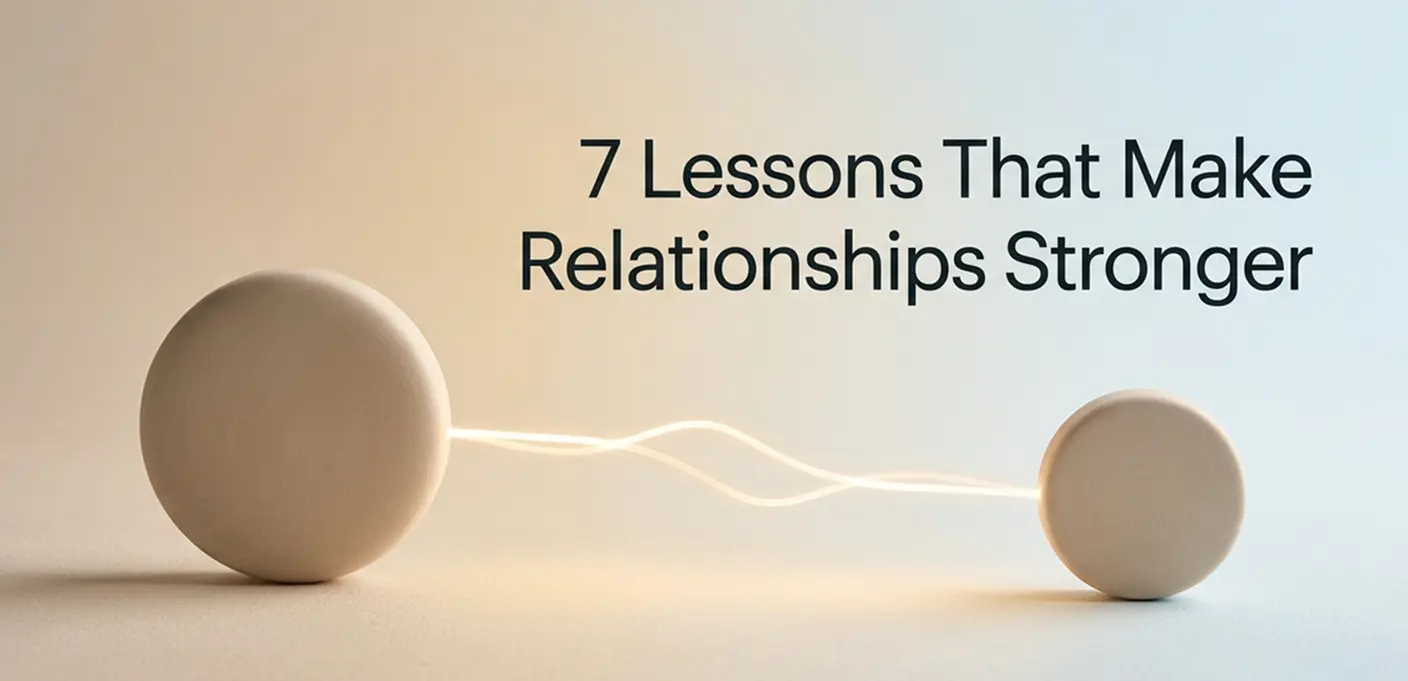
7 Lessons That Make Relationships Stronger (And Most People Learn Too Late)
The relationships that matter most are rarely lost in dramatic moments.
They erode quietly in the conversations that stayed surface-level, the needs that went unspoken, the small moments of disconnection that accumulated until the distance felt normal. Most relationship problems are not failures of love. They are failures of attention, the gradual replacement of genuine presence with comfortable assumption.
These 7 lessons are what the strongest relationships are actually built on. Not grand gestures or perfect compatibility but small, consistent, deliberate choices made in ordinary moments that most people don’t recognize as consequential until they’ve already passed.
When You Realize Listening Is Not the Same as Waiting to Speak
The Situation: The other person is talking, and you’re already composing your response, your experience, your opinion, your solution. You are technically present. You are not actually listening.
The Lesson: The person in front of you doesn’t always need your answer; they almost always need to feel genuinely heard.
The Insight: Most people listen to respond rather than to understand. The difference is felt immediately by the person speaking, whether or not they could name it. Being truly heard is one of the rarest and most bonding experiences available in human connection, and it costs nothing except the willingness to be fully present for someone else’s experience before inserting your own.
The Tip: Before responding in your next meaningful conversation, pause for two full seconds after the other person finishes speaking. Use that pause to ask one follow-up question rather than offering a response. The quality of what follows will be noticeably different for both of you.
“Being heard is so close to being loved that most people can’t tell the difference.”
“The best thing you can offer someone is your full, unhurried attention.”
When an Unspoken Expectation Creates a Felt Disappointment
The Situation: You expected something to be remembered, to be prioritized, to be considered, and it didn’t happen. You didn’t ask for it. You assumed it was understood. Now there’s a quiet hurt that neither of you has named.
The Lesson: Unspoken expectations are the quiet architects of most relationship resentment.
The Insight: People cannot meet needs they don’t know exist. What feels obvious to you, the support you needed, the acknowledgment you wanted, is often invisible to someone else operating from an entirely different internal world. The choice between expressing a need honestly and carrying the disappointment of its absence is not really a choice at all. One builds the relationship. The other slowly hollows it.
The Tip: When you notice a recurring disappointment, ask whether you’ve actually communicated the underlying need clearly, specifically, without expecting it to have been obvious. Most conflicts that feel like failures of care are actually failures of communication. Name what you need before you resent not having it.
“Expecting someone to know what you need without telling them is a setup for disappointment.”
“The need you don’t express becomes the resentment you can’t explain.”
When the Argument Is About More Than What It Appears to Be
The Situation: You’re arguing about something small, timing, or a comment that landed wrong. But the energy in the room is disproportionate to the thing itself, and neither of you can quite explain why.
The Lesson: Surface conflicts are almost always about the unmet need underneath them, and resolving the surface without addressing the underneath changes nothing.
The Insight: The dishes are not about the dishes. The comment is not just a comment. Repeated arguments about the same surface topics are the mind’s way of pointing at something deeper that hasn’t been named, a need to feel considered, appreciated, secure, or seen. Engaging only with the presenting issue is efficient and entirely ineffective. The question worth asking is not “who is right about this?” but “what is this actually about?”
The Tip: In your next conflict, pause the content-level debate and ask: “Is there something bigger underneath this for either of us?” The question feels vulnerable to ask and almost always produces a more honest and more useful conversation than the one it interrupted.
“Most arguments are just unmet needs looking for the wrong exit.”
“Solve the argument and you solve nothing. Understand what’s underneath it and you solve everything.”
When Consistency Matters More Than Intensity
The Situation: There are grand gestures, the significant gift, the meaningful trip, the big apology. And there are ordinary Tuesday evenings where you’re half-present, distracted, somewhere else. The relationship is built more by the Tuesdays than the gestures.
The Lesson: Relationships are not maintained by occasional intensity; they are built by consistent, small acts of genuine attention.
The Insight: The mind records patterns, not highlights. The person who shows up reliably in ordinary moments builds a deeper sense of safety and belonging than the person who appears dramatically in significant ones. Grand gestures matter, but they cannot compensate for consistent unavailability. What makes someone feel loved over time is not the memorable moments. It is the reliable quality of the unremarkable ones.
The Tip: Identify one small, consistent act of attention you could offer daily or weekly, a genuine question, an undistracted conversation, a moment of acknowledgment. Not a scheduled event, a habitual orientation toward the person. The cumulative effect of that consistency will outperform any gesture you could plan.
“You are loved most in the ordinary moments. Show up for those.”
“Consistency is not romantic. It is what romance is actually built on.”
When You Choose to Repair Instead of Withdraw
The Situation: Something has created distance, a disagreement, a misunderstanding, a bad day that spilled into the relationship. The easier choice is to wait for the other person to close the gap. You close it instead.
The Lesson: The willingness to repair and move toward rather than away after conflict is one of the most reliable predictors of relationship longevity.
The Insight: Withdrawal after conflict is instinctive and understandable. It protects you from further vulnerability while emotions are still high. But the habit of waiting for the other person to apologize first, to reach out first, to close the gap first creates standoffs that outlast the original conflict and produce more damage than the conflict itself. The person who repairs first does not lose. They demonstrate that the relationship matters more than the score.
The Tip: After your next conflict, make one small repair move within 24 hours, not a full resolution, just a gesture of reconnection. A text, a cup of coffee offered, a simple acknowledgment that you’d rather be close than right. That single move almost always opens the door to the rest of the conversation.
“The person who reaches first doesn’t lose. They show what they value more than winning.”
“Repair is not weakness. It is the most relationship-intelligent move available after conflict.”
When You Realize You’ve Been Reacting to History, Not the Person
The Situation: Someone does something that triggers a response far larger than the situation warrants. The intensity surprises even you. Later, you recognize the reaction was not entirely about them.
The Lesson: We often respond to the people we love through the filter of every person who hurt us before them, and that filter distorts what’s actually happening.
The Insight: Old wounds don’t stay in the past. They travel forward, attaching themselves to new situations and new people, producing reactions that make sense only in reference to something that happened long before the current relationship existed. Recognizing this pattern does not make the reaction wrong or invalid; it makes it understandable and, more importantly, workable. You cannot change what you haven’t named.
The Tip: When a reaction feels disproportionate to the current situation, ask honestly: how much of this is about right now, and how much is about something older? That question creates just enough distance to respond to what’s actually in front of you rather than what it reminded you of.
“Not every reaction belongs to the person receiving it. Check who you’re actually responding to.”
“The people you love deserve to be seen as themselves, not as echoes of everyone who came before.”
When Honesty Feels Like a Risk Worth Taking
The Situation: There is something true that needs to be said about how you’re feeling, what you need, and what isn’t working. You’ve been editing it, softening it, waiting for a better moment. The better moment keeps not arriving.
The Lesson: Relationships deepen through honesty, not through the careful management of it.
The Insight: The version of yourself you present to protect the relationship is not the version the relationship can actually hold. Intimacy requires the real thing, the need that feels too much to ask for, the feeling that feels too vulnerable to expose, the truth that might change something. The risk of honesty is real. But the cost of its absence, the slow performance of closeness without its substance, is larger and longer-lasting.
The Tip: Identify the one honest thing you’ve been editing in a relationship that matters to you. Then say a version of it not perfectly, not completely, but honestly. You don’t need the full speech. You need the first true sentence. Most real conversations begin there.
“Closeness requires the real version of you, not the edited one.”
“The honest thing you’ve been withholding is usually the thing that would bring you closer.”
A Final Thought
Strong relationships are not built by people who have it all figured out. They are built by people who keep choosing to listen, to speak honestly, to repair, to show up in the ordinary moments, to see the person in front of them clearly.
None of these lessons requires perfection. They require only the willingness to be a little more present, a little more honest, and a little more intentional than the day before.
The relationship you want is almost always within reach of the choices available to you today.