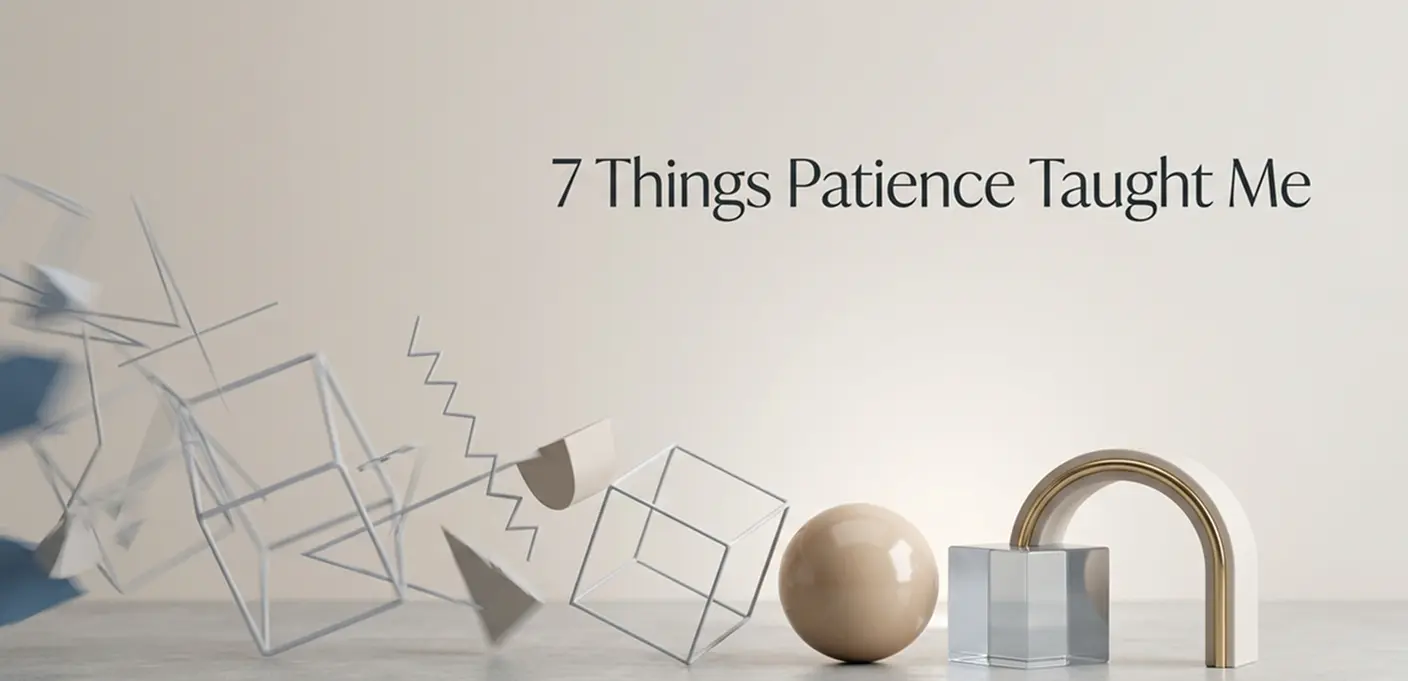
7 Things Patience Taught Me That Rushing Never Could
We live in a culture that rewards speed. Fast replies, fast results, fast growth. And somewhere along the way, waiting started to feel like falling behind.
But some of the most important things, the ones that actually last, don’t arrive on your timeline. Not because life is cruel, but because certain things genuinely need time to become what they’re supposed to be. Including you.
These seven lessons won’t make waiting easier overnight. But they might change what you think waiting means, and that shift turns out to be everything.
When You Want the Result Before You’ve Done the Work
The Situation: You start something new, a goal, a habit, a project. A week in, there’s no visible progress. The gap between where you are and where you want to be feels enormous, and the urge to quit or pivot is loud.
The Lesson: Most growth happens in the phase that produces no visible evidence.
The Insight: What looks like stagnation is often the slow, invisible work of foundations being laid. The problem isn’t that nothing is happening; it’s that nothing is showing yet. Patience here isn’t passive waiting. It’s continuing to act without the reward of proof. The people who build something real are the ones who stayed through the phase that looked like nothing.
“Not all progress is visible. Some of it is just you not quitting.”
When a Relationship Is Moving Slower Than You Expected
The Situation: You care about someone, a friendship, a romance, a professional connection. But it’s not deepening at the pace you hoped. You wonder if it ever will, or if you’re reading it wrong.
The Lesson: Trust is built in the accumulation of small, unremarkable moments, not in grand gestures or timelines.
The Insight: Depth in relationships isn’t manufactured; it accretes. Every low-stakes interaction, every ordinary conversation, every time someone shows up consistently, these are the actual building blocks. Trying to accelerate intimacy usually produces the opposite. The relationships that feel most solid weren’t rushed into depth. They were allowed to arrive there.
“Some connections take longer to open. That doesn’t mean they’re not opening.”
When You’re Healing From Something That Should Be Over By Now
The Situation: Time has passed. By every external measure, you should be fine. But the thing, the loss, the hurt, the transition is still present. You’re frustrated with yourself for not being further along.
The Lesson: Healing doesn’t follow a schedule, and judging yourself for its pace only slows it down.
The Insight: The pressure to be over it adds a second layer of pain on top of the first. You’re not just carrying the original wound, you’re carrying shame about still carrying it. Patience with your own healing isn’t weakness or self-indulgence. It’s the recognition that some things need to be processed fully, not just survived quickly. Moving on before you’re ready doesn’t make you stronger. It just moves the unresolved thing underground.
“You don’t fall behind in healing. You just haven’t finished yet.”
When You’re Watching Someone Else Get What You’re Working Toward
The Situation: Someone in your orbit, your field, your social circle, your feed has achieved something you’re still in the process of building. The comparison is instant and unkind.
The Lesson: Someone else’s early arrival says nothing about your timeline.
The Insight: Comparison collapses context. You don’t know how long they were actually working before you noticed. You don’t know what they traded, what they bypassed, what’s quietly unfinished in their story. Your path has a different set of variables, different starting conditions, different obstacles, and different definitions of arrival. Patience in the face of comparison isn’t resignation. It’s the refusal to measure your chapter against someone else’s.
“Their timeline was never meant to be yours. Stop using it as a measuring stick.”
When a Decision You Made Isn’t Showing Results Yet
The Situation: You made a change, a bold one, maybe a scary one. You’ve been waiting to see if it was right. The feedback hasn’t come. The validation is silent. Doubt is filling the gap.
The Lesson: Good decisions often feel uncertain for longer than bad ones do.
The Insight: This is counterintuitive but true: the choices that align with something real tend to require a longer incubation period before they confirm themselves. Bad decisions often produce fast, visible noise, obvious friction, or quick collapse. Good ones ask you to hold on through the ambiguity. Patience here is a form of fidelity, staying with your decision long enough to actually find out what it becomes.
“Silence after a brave decision isn’t a bad sign. It’s just the world catching up.”
When You’re Tired of Being in the Middle of Something
The Situation: You’re not at the beginning anymore, but you’re clearly not at the end either. You’re somewhere in the middle, the least glamorous, least motivating, least-discussed phase of any long process.
The Lesson: The middle is where the actual work happens, and it’s supposed to feel like this.
The Insight: The beginning has novelty. The end has arrived. The middle has neither just the quiet, unglamorous requirement to continue. But the middle is also where character is formed, where skills compound, where you find out what you’re actually made of when the excitement is gone, and the finish line isn’t visible yet. Patience in the middle isn’t about liking it. It’s about understanding that this is precisely where most people stop, and you don’t have to.
“The middle is hard for everyone. The people who finish are the ones who stayed anyway.”
When Life Isn’t Moving at the Speed You Planned
The Situation: You had a version of how things would look by now. A certain age, a certain stage, a certain shape to your life. It hasn’t gone that way. And sometimes, quietly, that gap between expectation and reality is exhausting.
The Lesson: A life that doesn’t match your original plan isn’t a failed life, it’s an honest one.
The Insight: Plans are written with incomplete information. They’re based on who you were when you made them, what you knew then, what you could see from that vantage point. Life moving differently isn’t proof that you’ve fallen short. It’s proof that reality is more complex and often more interesting than the plan accounted for. Patience with your own unfolding means releasing the plan enough to see what’s actually being built instead.
“Your life not going to plan doesn’t mean it’s going wrong. It means it’s going real.”
A Final Thought
Patience isn’t about being passive. It’s not about tolerating things that should change or waiting quietly when action is needed.
It’s about learning to tell the difference between a process that needs more time and a problem that needs to be addressed. Between growth that’s happening invisibly and stagnation that needs interruption.
The most patient people aren’t the ones who never feel urgency. They’re the ones who’ve learned that urgency isn’t always the right response and that some things, given enough time and enough trust, have a way of arriving exactly when they’re meant to.
You’re not behind. You’re in the middle of something that isn’t finished yet.